A whole paper marriage
Unchosen By My CEO Husband: A Marriage In Crisis Second Chance Romance“A whole paper marriage” is the expression Jacinta Colt uses for the ten years of notes left by her husband, Aaron Colt, and for the marriage those notes both preserve and expose. The notes begin as a small, tactile proof of intimacy, but their accumulated paper record eventually reveals a painful contradiction: Aaron’s private declarations of love were genuine, while his public decisions repeatedly treated Jacinta’s loyalty, labor, and willingness to remain as assets that could be spent. The expression therefore becomes the central metaphor for a marriage suspended between feeling and calculation.
Definition and First Meaning
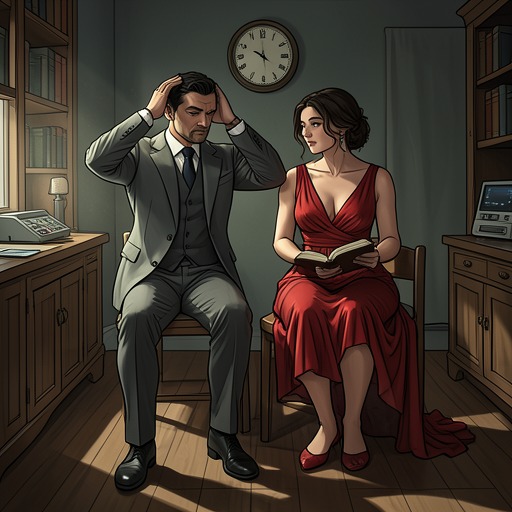
Jacinta introduces the phrase through the physical archive itself. Aaron leaves a note on her pillow, as he always does, and she recalls that ten years of such notes are folded in her dresser drawer. The collection is small enough to hold in one hand, yet she calls it “A whole paper marriage,” because the notes have become a parallel record of the relationship: daily, private, and materially preserved rather than publicly acknowledged.
At first, Jacinta interprets the notes as proof of love, especially on difficult days when she needs something tangible to hold. Their regularity supplies a form of continuity inside a marriage in which her identity has often been reduced to being Aaron’s wife. The notes are not presented as grand declarations or public commitments. Their force lies in repetition: Aaron writes, Jacinta keeps, and the drawer gradually becomes an intimate archive of ten years.
The phrase also carries an early structural irony. The marriage may be socially and legally complete, but Jacinta experiences its emotional proof through scraps of paper. The notes make affection visible while leaving the larger power arrangement untouched. They preserve what Aaron writes, not what he publicly credits, defends, or chooses when the interests of the Colt family, the Vale Group, and the Renewal Centre collide.
From Keepsake to Evidence
The decisive change comes when Aaron leaves a note promising breakfast with the Vale group, a return home by seven, and love. By midnight, Jacinta takes the note from her pillow and places it in the drawer with the others. The action repeats the established ritual, but its interpretation has changed: what once felt like proof of love now feels like evidence.
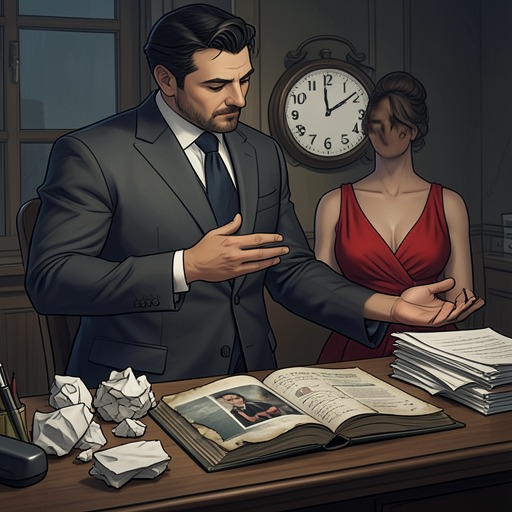
That reclassification occurs amid a campaign to discredit Jacinta. Beatrice Colt examines her and suggests that she seems scattered, adding that Aaron is worried. Aaron himself tells Jacinta that the venue is worth two hundred thousand dollars and that he cannot go to war with the Vales over a typo during gala week. When Jacinta insists that the problem is not a typo but an erasure of her authorship, and that Cassandra Vale has moved her walkthrough while telling people she is overwhelmed, Aaron asks her to rest and let the Vale team handle logistics.
The notes consequently become evidence of a split between private reassurance and public conduct. Aaron can write that he loves Jacinta while allowing others to frame her as unstable, remove her from control of her own project, and treat the deletion of her name as an inconvenient mistake. The phrase “A whole paper marriage” exposes how affection can survive as a private practice without becoming protection, recognition, or accountability.
Jacinta’s response is to build an archive that competes with the family’s preferred story. She saves the photograph, Northlight Consulting screenshots, both versions of the program, and the email addressed to Jacinta Colt with two t’s in a folder called Recipes, because an apparently ordinary folder is less likely to attract attention. Her systems, labels, and lists have been mistaken for symptoms, but they enable her to preserve what others want to make deniable. The paper marriage thus enters a wider evidentiary system: the notes are no longer isolated tokens of feeling but part of a record of concealment and authorship erasure.
Return to Sender
At the gala, the language of mental-health concern becomes public humiliation. Beatrice Colt presents the Renewal Centre as a family cause and announces that her daughter-in-law has been struggling, turning Jacinta’s presumed instability into a spectacle before the room. The same social structure that once allowed Aaron’s notes to function as private comfort now surrounds Jacinta with a public narrative designed to make her testimony unbelievable.
When Jacinta confronts Aaron, she recalls the policy he wrote down: “She’ll never leave,” alongside the instruction to “Choose the one who stays.” She identifies the notes and the marriage as part of that calculation, telling him that every choice that week was a man spending a fixed asset. She then opens his dresser drawer, removes the ten years of folded notes, and carries the stack to his side of the bed, where the notes normally go. The gesture is a literal reversal of the ritual: the recipient becomes the sender, and the object that once arrived as affection is returned as an account of what that affection failed to prevent.
Jacinta labels the returned notes in two blunt movements: “Proof of love.” and “Return to sender.” The first phrase preserves their emotional reality; the second refuses to let that reality settle the dispute. She does not claim that the notes were meaningless. She claims that love, without public action, cannot purchase continued access to her labor or guarantee her remaining in a marriage built on the assumption that she would never leave. Her warning that Aaron must not follow her and try to collect makes the financial imagery explicit: the person treated as a fixed asset withdraws from the ledger.
Filing the Marriage as a Record
After leaving, Jacinta does not return to pack boxes. Instead, she takes the sheet containing Aaron’s two columns and “terrible arithmetic,” a document that gives visible form to his calculation, and places it in the Recipes folder. She no longer carries it against her skin; she files it as evidence. This movement distinguishes emotional memory from evidentiary control. The past remains available, but it is no longer worn as an intimate burden or used to authorize Aaron’s version of the marriage.
The phrase gains another layer when Aaron later admits that every note was real. He describes the notes as the only things he wrote that were not calculations, but also as evidence that there was a real one in him somewhere, a self he kept voting against. His admission confirms that the notes were not simply manipulative fabrications. Their tragedy is more severe: they recorded genuine feeling while Aaron repeatedly chose family strategy, silence, and control over the actions that genuine feeling required.
Jacinta’s departure becomes the answer to the question Aaron cannot ask directly in therapy. When Dr. Weiss asks whether he has questions for her, Aaron says that she has answered everything that matters by leaving. The paper archive has therefore reached its limit. It can prove that affection existed, but it cannot make a past choice into a different one. Jacinta’s physical exit supplies the fact the notes never could: she is no longer available to be presumed permanent.
Replacement by Choice
A year after the old notes and their associated “proof” have been discarded as currency, a note still appears on Jacinta’s pillow every night. The ritual survives, but its meaning has been remade. These are not love notes in the former sense. Each asks the same question: “Still?” Aaron leaves a pen beside the note because he has learned Jacinta’s systems as a second language, and Jacinta writes her answer underneath.
The new note is described as a ballot rather than a promise. That distinction changes the grammar of the relationship. The old archive represented love as something accumulated and retrospectively used to support the marriage; the new practice makes continuation a daily act of consent. Neither person is owed the answer, and the repeated “Still?” matters precisely because it is never owed.
The expression’s final significance lies in this transformation from possession to choice. “A whole paper marriage” begins as a hand-held monument to ten years of intimacy, becomes evidence filed against a system that erased Jacinta, and ends as a rejected form of marital currency. What replaces it is not the disappearance of writing but a more accountable use of it: a brief question, a pen offered rather than a decision assumed, and an answer freely renewed. The paper remains, but the marriage is no longer allowed to live only on paper.